




Lake Vico is a complex socio-ecosystem in which agriculture, tourism, and the environment are closely interconnected. The transport of nutrients from agricultural land to the lake, together with the long water renewal times, has promoted eutrophication processes. Despite existing protection measures, the lake is still subject to significant pressures, particularly related to soil erosion from both agricultural and forested land and the effects of climate change. Effective interventions are therefore needed, shared among all stakeholders – public and private – to halt ecosystem degradation, reduce nutrient inputs into the water as much as possible, improve land management, and preserve the local economy. In this context, integrated protection and restoration solutions are essential, with particular attention to nature-based solutions (NBS).
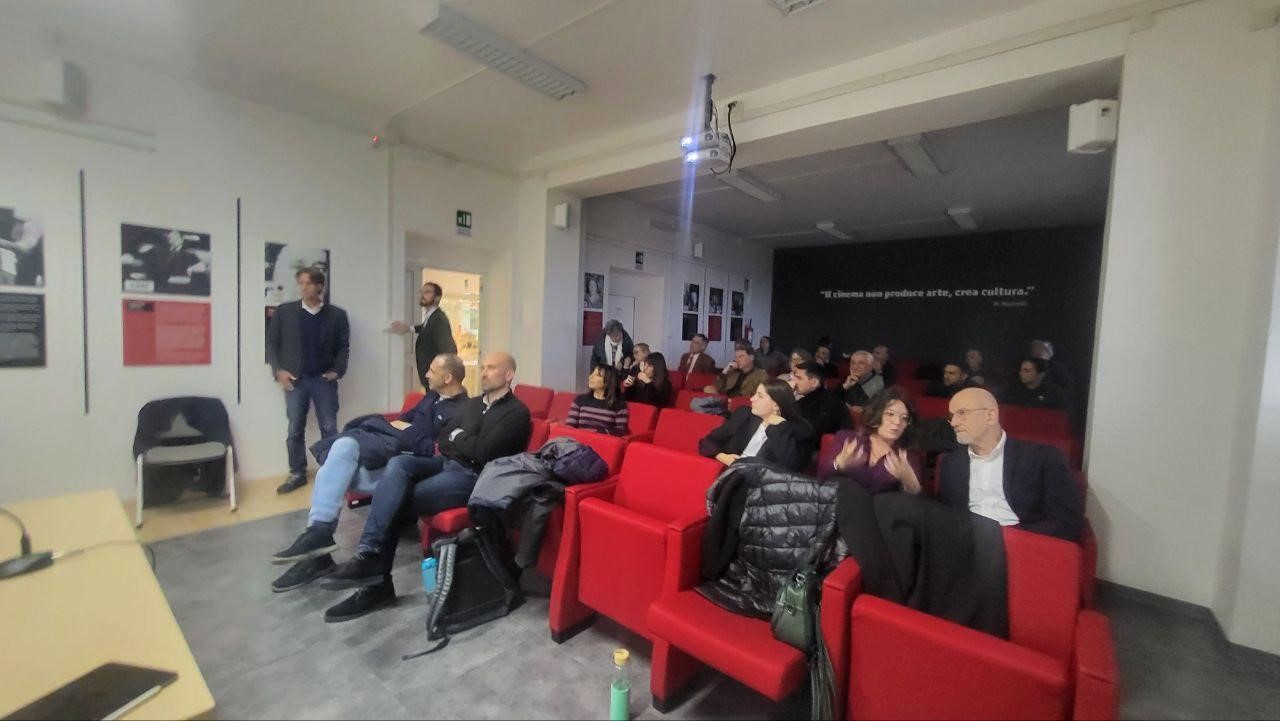
To address these challenges, a participatory process was launched involving farmers, local authorities, businesses, researchers and associations, within the framework of an evaluation exercise based on Participatory Multi-Criteria Analysis. The objective was to compare different possible alternative management strategies and identify those that are most widely supported and sustainable. To this end, the University of Tuscia, together with the Fondazione Eni Enrico Mattei, organized a workshop on November 21, 2025, aimed at explaining the method adopted by the EUROLakes project and the evaluation exercise, followed by an online survey.
The alternatives considered in the process include:
- Current management (Business-As-Usual, BAU)
- Optimization of grass cover in hazelnut groves
- Environmental conservation and restoration
- Nature trail
Each alternative represents a set of specific actions involving different local stakeholders.
How the process was carried out
The possible solutions—represented by alternative packages of actions—were co-developed with local stakeholders and evaluated by considering four types of benefits (“returns”): environmental, social, economic, and community (inspirational) value. The process took place in two phases:
- an initial evaluation by experts, to assess which solutions were realistically applicable;
- an evaluation by participants, who expressed their preferences.
All the main stakeholder groups were involved, with a total of 25 participants completing the online survey.
Which returns were considered most important
The chart shows the importance that participants assigned to the four types of benefits. The wider colored areas indicate where responses are more concentrated, while more elongated shapes reflect greater diversity of opinions among participants. When the shape is more compact, it means that the evaluations are more similar to each other.
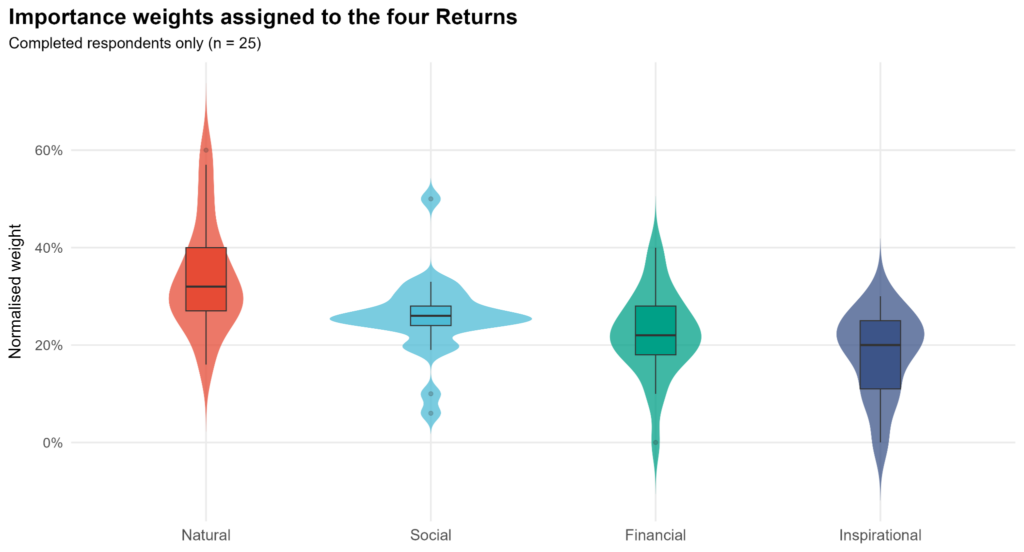
- Natural return is, on average, the most important → Environmental protection is the top priority for many participants, particularly for farmers, research institutions, and local government bodies.
- Social return is the second most relevant → Benefits for the local community are also important; the chart shows strong agreement among participants on the weight assigned to this benefit.
- Financial and inspirational returns rank lower, although still relevant → Economic and recreational-cultural aspects remain priorities, respectively, for local businesses and NGOs.
Which solutions are preferred
The chart compares the different management solutions, showing their overall score relative to the best option (set at 100%). The higher the value, the more positively the solution was evaluated overall.
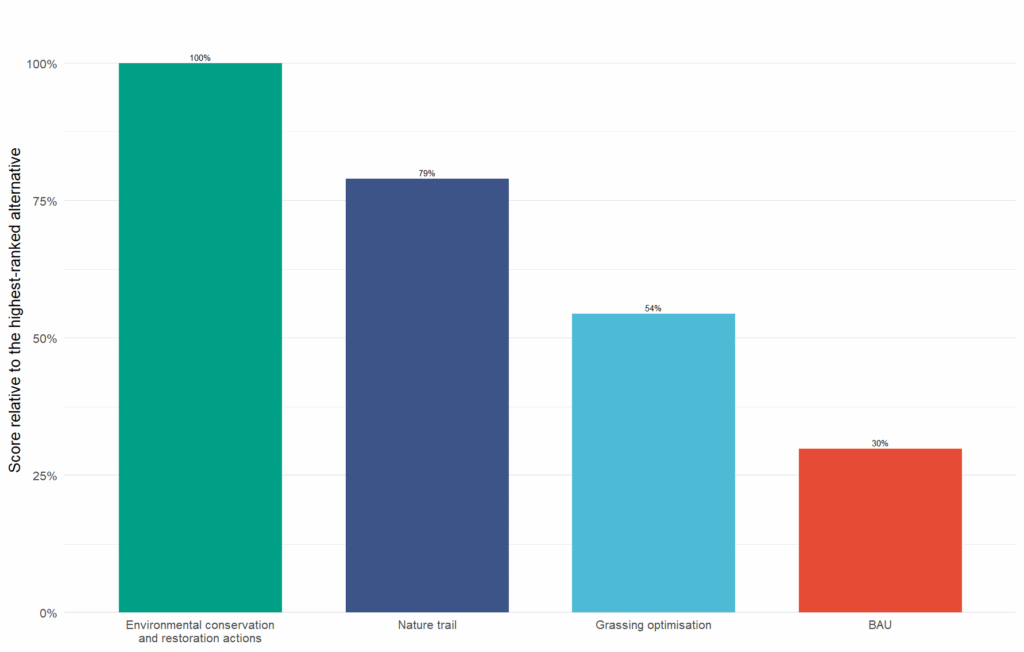
The score takes into account both how important each participant considers the different benefits (returns) and how effective each solution is perceived to be in delivering those benefits. The results clearly show that:
- Environmental conservation and restoration actions are considered the best overall option.
- The nature trail ranks as the second most appreciated solution.
- Optimization of grass cover is seen as an intermediate solution.
- Maintaining the current management (BAU) is generally the least preferred option.
Overall, solutions aimed at environmental improvement are considered the most effective for the future of the lake. Despite their greater complexity, restoration actions are the most preferred, indicating openness toward more ambitious interventions, even if they are more demanding from a technical and economic perspective. It is important to note that these actions are mainly the responsibility of local government bodies, whereas grass cover optimization and current management primarily concern privately owned agricultural land.
Differences among groups
Not all groups think the same way. The following chart shows how different stakeholder groups (farmers, local authorities, businesses, NGOs, and research institutions) evaluate the considered solutions. Each panel represents a group. The dots indicate individual participants’ evaluations, while the horizontal line shows the central value of the group’s opinions. When the dots are widely spread, it means there is greater diversity of opinions within the group. When they are more clustered, there is stronger agreement. In general, the closer the score is to 1, the better the solution is considered.
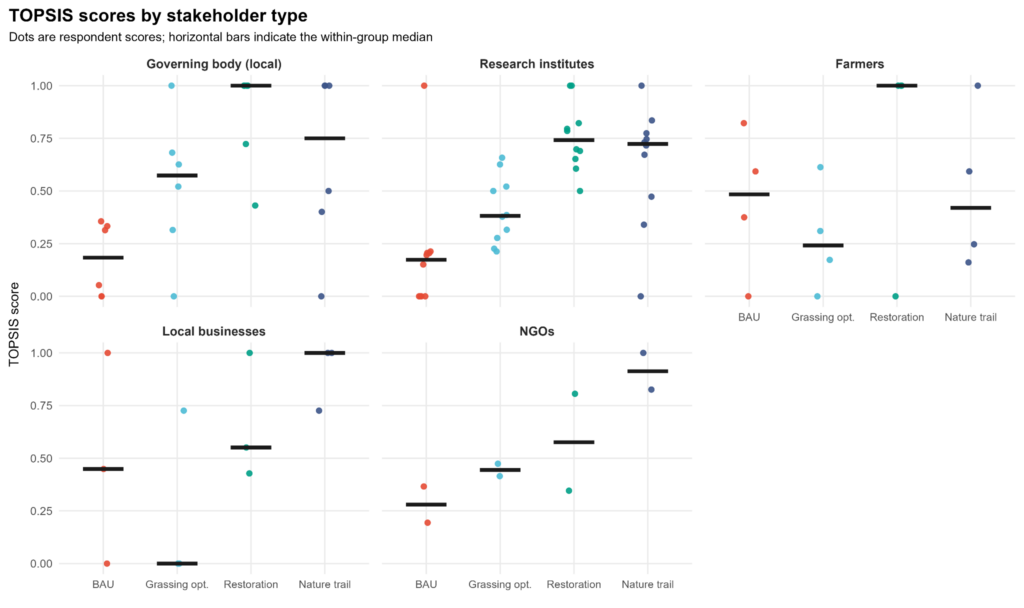
From this analysis, it emerges that the different groups generally behave as follows:
- Farmers: significant diversity of preferences → Potential difficulties in reaching consensus within this group on the various solutions. However, it is clear that grass cover optimization is the least accepted option.
- Local authorities and researchers: strong preference for restoration → Greater focus on long-term environmental objectives.
- Local businesses: positive evaluation of both the nature trail and restoration → Interest in both local development and environmental quality.
- NGOs: very positive evaluation of the nature trail and restoration, less so for BAU → Strong orientation toward environmental improvement solutions.
These differences reflect varying interests, constraints, and priorities, but the results also help identify which alternatives show low convergence across groups or within the same stakeholder group. For example, there appears to be a need to better demonstrate the effectiveness and feasibility of certain alternatives (BAU and grass cover optimization) to achieve broader acceptance of these practices at the territorial scale.
What concerns participants the most and what their priorities are
At the beginning of the survey, participants were asked to indicate the main challenges and priorities for Lake Vico. The size of the words reflects how often each issue was mentioned: larger words correspond to more frequently cited concerns. The most frequent words indicate the most commonly mentioned themes, but not necessarily those considered the most important by everyone.
The figure below shows the main issues affecting Lake Vico as reported by the participants.
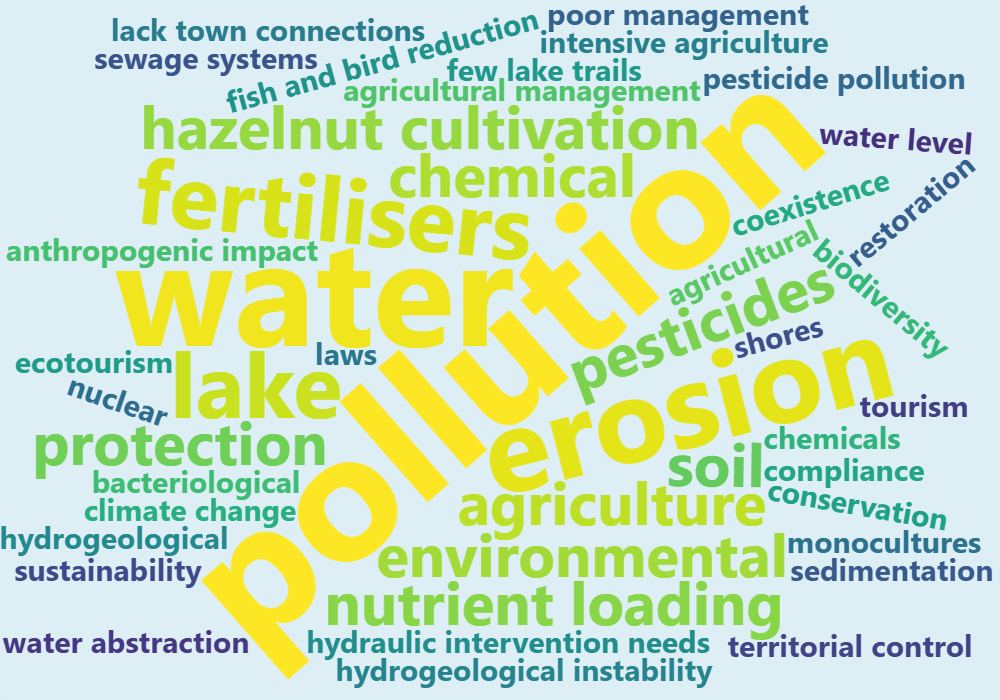
The above visualisation highlights a strong emphasis on environmental pressures and degradation processes affecting the Lake Vico system. Frequently occurring terms such as pollution, water, erosion, fertilisers, pesticides, nutrient loading, and hazelnut cultivation dominate the wordcloud, pointing to widespread concern regarding water quality deterioration, diffuse agricultural pressures, and soil–water interactions.
The next figure shows the priorities for the future of Lake Vico.
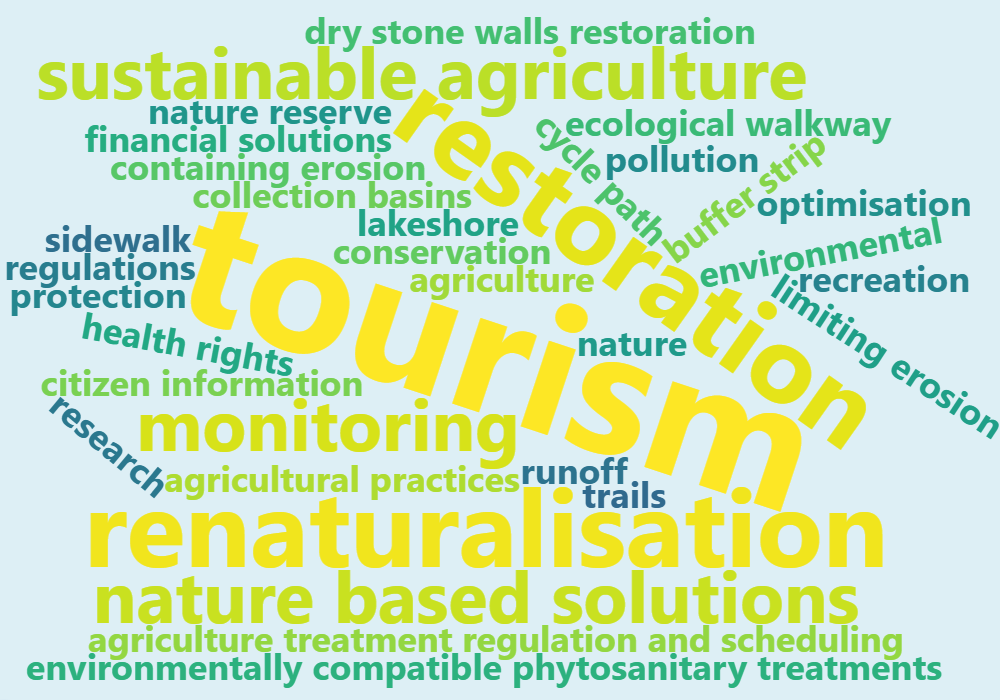
The above visualisation reveals a clear shift towards solution-oriented concepts. Prominent terms include restoration, renaturalisation, monitoring, nature-based solutions, sustainable agriculture, and tourism. This indicates that stakeholders not only recognise key problems, but also articulate concrete directions for intervention and long-term management.
Conclusions
The intervention priorities perceived by stakeholders are fully reflected in the alternatives evaluated in the multi-criteria exercise. All the alternatives, in fact, aim to control soil erosion and improve water quality. In addition, the objective of sustainable tourism development is mainly addressed through the nature trail; environmental restoration and renaturalization are represented in particular by the environmental conservation and restoration alternative, but also by the nature trail and current management; sustainable agriculture is instead included in current management and grass cover optimization.
This first phase highlighted a clear shared priority among stakeholders: improving the ecological status of Lake Vico. The proposed solutions were positively evaluated, with some differences linked to the roles, needs, and priorities of the different groups. In particular, environmental restoration actions and the creation of a nature trail are considered capable of generating the greatest environmental, social, and economic benefits. Other actions (current management and grass cover optimization), however, require further investigation to demonstrate their effectiveness.
To move from theory to practice, it will be essential to:
- strengthen coordination among actors, especially those with more divergent preferences;
- identify technical and financial support mechanisms for implementing stakeholders;
- maintain active dialogue among stakeholder groups;
- implement pilot actions to demonstrate the proposed measures and assess their effectiveness and economic sustainability.
Without these conditions, even the most widely supported solutions risk remaining on paper or resulting in isolated interventions, with limited effects on the overall health of the lake. In the next phase, the EUROLakes project will allocate resources to implement these actions through an integrated and participatory approach. For updates on the next steps, you can consult the EUROLakes project’s Facebook page and website.
Contributors: Fondazione Eni Enrico Mattei and University of Tuscia