




What if the nutrients fueling harmful algal blooms could instead fertilize crops, power new industries or inspire innovative approaches to known issues?
That was the guiding question during the third Mission Lakes webinar, “Turning Pollution into Resources”, which brought together 57 participants from across Europe.
The event is part of the Mission Lakes webinar series jointly organized by EUROLakes, Future Lakes, ProClean Lakes and FERRO projects under the EU Mission Ocean framework. Since launching in August 2025, the series has become a space for open exchange – not just about environmental challenges, but about practical, sometimes bold solutions that connect science, policy and local communities.
Lake Vico: Restoring Nature by Rebuilding Trust
EUROLakes opened the discussion with a spotlight on Lake Vico – our demo site in the Lazio region of Italy. A volcanic lake, 40 meters deep and surrounded by a landscape shaped by agriculture and history, Lake Vico is simultaneously beautiful and fragile.
Over the past 70 years, the basin has changed dramatically. Hazelnut orchards expanded by 142%. Urban areas grew by 145%. Arable land almost disappeared. These shifts, combined with erosion, have increased phosphorus inputs and triggered recurring algal blooms. The lake also faces naturally elevated arsenic concentrations.
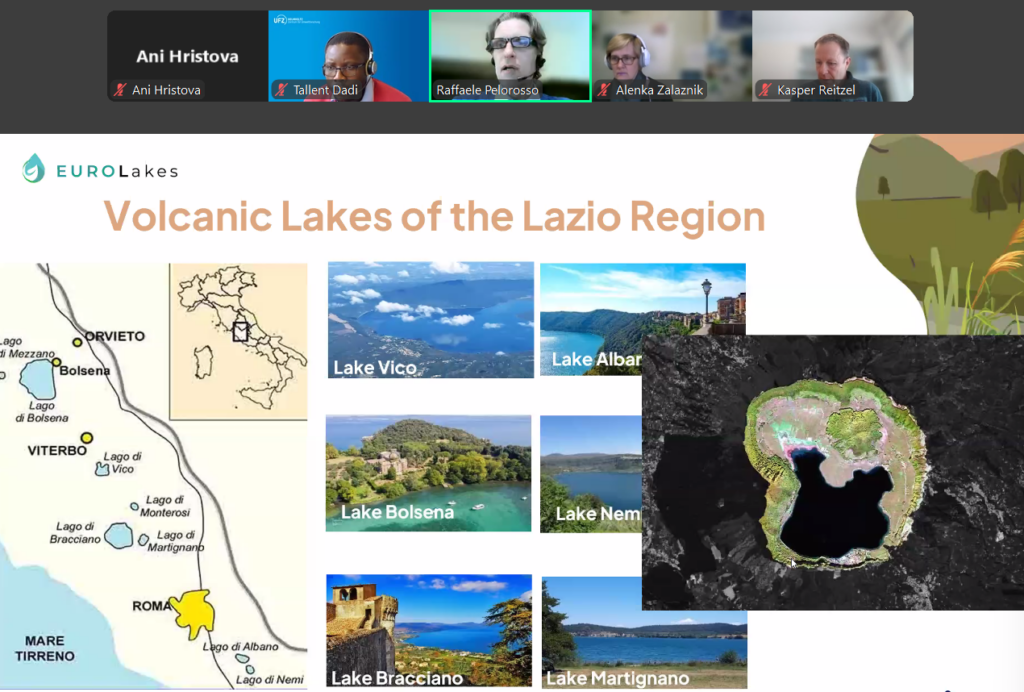
But as Prof. Raffaele Pelorosso from the University of Tuscia reminded participants, eutrophication here is not only a biophysical issue. It is also social.
Opposing views between local agricultural and tourist sectors. Tensions over shoreline buffers. Overlapping institutional responsibilities. Weak communication. A declining sense of shared stewardship. All of these led to what EUROLakes team refers to as “social degradation”.
Addressing this phenomenon is as important as reducing nutrient loads and that is why the project’s work at Lake Vico goes beyond monitoring and modelling. In 2025, the EUROLakes team carried out comprehensive stakeholder mapping and launched an intensive engagement process:
- A farmer‑focused workshop in Caprarola to build trust and recognize good practices already implemented on private land.
- A multi‑stakeholder workshop conducted as a PMCA‑type exercise to co‑design alternative management options.
- A participatory online platform developed to support joint evaluation of different scenarios and trade‑offs.
The goal is clear: reactivate social capital, reduce conflicts and co-create nature-based solutions that balance agriculture, tourism and conservation. And if there is a key takeaway from Vico Lake, it is that restoration is not something that is imposed on a community – it is something built together with it.
Recycling Sediments: From Lake Bottom to Farm Field
The FERRO project demonstrated how lake restoration and circular economy mindset can go hand in hand when tackling eutrophication and the global phosphorus crisis. Human activities have expanded the phosphorus cycle to roughly 47 times its natural flux, while Europe remains heavily dependent on imported phosphate rock.
In many lakes, “legacy phosphorus” stored in sediments keeps feeding blooms even after external sources are reduced. FERRO’s approach? Remove the nutrient-rich top sediment layer and recycle it as fertilizer.
In Lake Mustjärv in Estonia, sediment dredging combined with reuse in agriculture significantly reduced phosphorus concentrations and cyanobacterial blooms. In Lake Væng in Denmark, a newly developed gentle dredger removes only the upper 20 cm of sediment – the layer richest in phosphorus – enabling targeted removal and recycling.
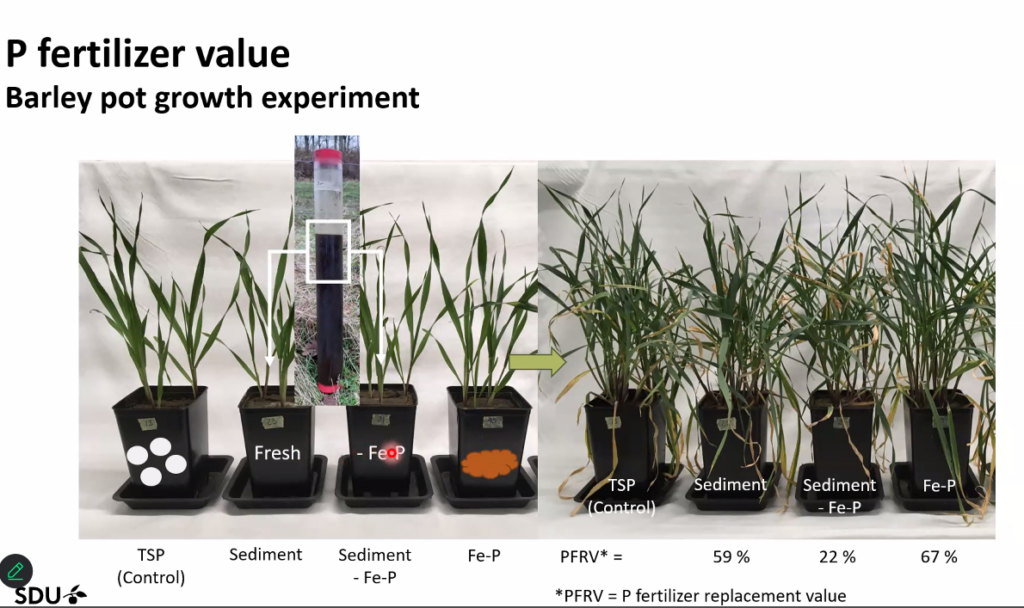
Greenhouse and field experiments with barley, rye‑grass and peas show that dredged sediment can replace up to two-thirds of conventional triple super phosphate (TSP) fertilizer. What is more, iron-bound phosphorus in sediment is less soluble, lowering the risk of leaching and runoff.
At the same time, the team is addressing concerns around contaminants such as cadmium and PFAS, exploring industrial hemp phytoremediation and other nature-based treatments to make sediment reuse safe and viable. Their ambition is not just ecological effectiveness, but also cost-competitive, circular restoration.
Microalgae and New Value Chains
Pollution as a resource was explored through microalgae innovation.
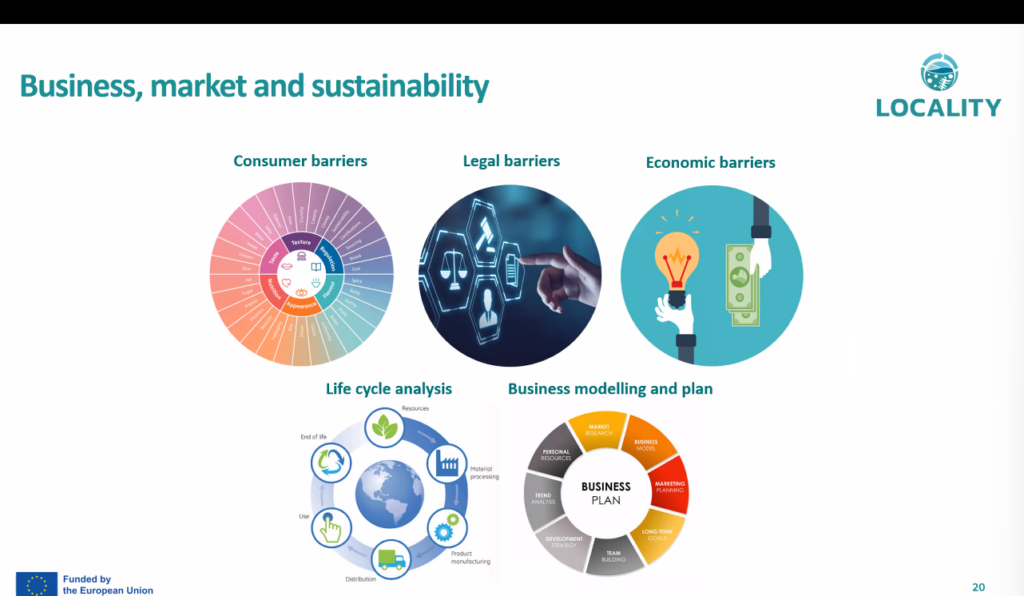
Dr. Margarida Costa from NIVA, presented the Locality project, closely linked to Future Lakes being a Mission Ocean project too, which is building circular industrial ecosystems that connect nutrient-rich wastewater streams with microalgae cultivation. From aquaculture effluents in Norway to greenhouse wastewater in the Netherlands and textile industry side streams in Sweden, waste nutrients become feedstock for algae production.
With access to over 2,000 microalgae strains, researchers are screening and scaling up microalgae for use in:
- Agricultural biostimulants and biocontrol products
- Natural textile dyes and antimicrobial additives for sportswear
- Aquaculture feed ingredients
- Alternative protein foods such as chlorella‑based omelets, fish analogues and sausage‑type formulations
It’s a powerful message: wastewater is not necessarily waste. With the right match between strain and stream, it becomes a growth medium for new products and business models.
Meanwhile, ProClean Lakes turned attention to oligotrophic systems such as Lake Trichonis, the largest lake in Greece. The lake hosts specialized, slow‑growing microalgal communities that thrive in nutrient‑poor conditions. These organisms do not only act as sensitive indicators of ecosystem health but also play key roles in nutrient recycling, water quality regulation, oxygen production and carbon sequestration. Additionally, they represent a valuable untapped genetic and biotechnological resource.
By isolating and cultivating indigenous strains, ProClean Lakes is exploring how local biodiversity can support bioremediation and high-value applications in food, cosmetics and other sectors, while safeguarding fragile ecosystems.
Shared Challenges, Shared Momentum
A lively and open discussion followed the presentations. Participants debated how to improve water quality by steering internal nutrient cycling and food webs. They examined the feasibility of sediment removal in deeper lakes like Lake Vico, where complementary measures might be needed. And they stressed the importance of recognizing co-benefits – from biodiversity, and greenhouse gas reduction to tourism and drinking water security – in cost–benefit analyses of restoration options.
Perhaps most encouraging were the emerging connections: new collaboration ideas between ProClean Lakes and NIVA on microalgae biotechnology, and closer networking among Italian partners in EUROLakes and Future Lakes.
The webinar series will continue, rotating among the four sister projects. The next session – hosted by EUROLakes in spring 2026 – will dive deeper into innovative and integrated approaches for restoring and protecting Europe’s natural lakes.
What this third webinar made clear is that lake pollution is not only a challenge. With the right science, governance and collaboration, it can become part of the solution.
Stay tuned and join the conversation.