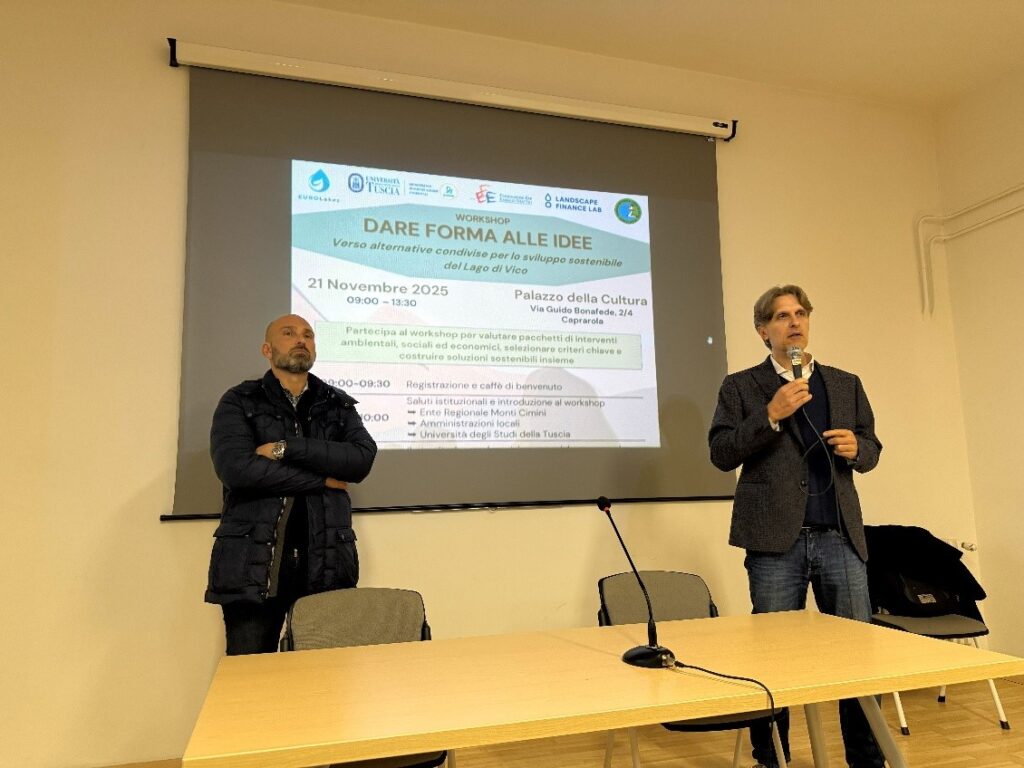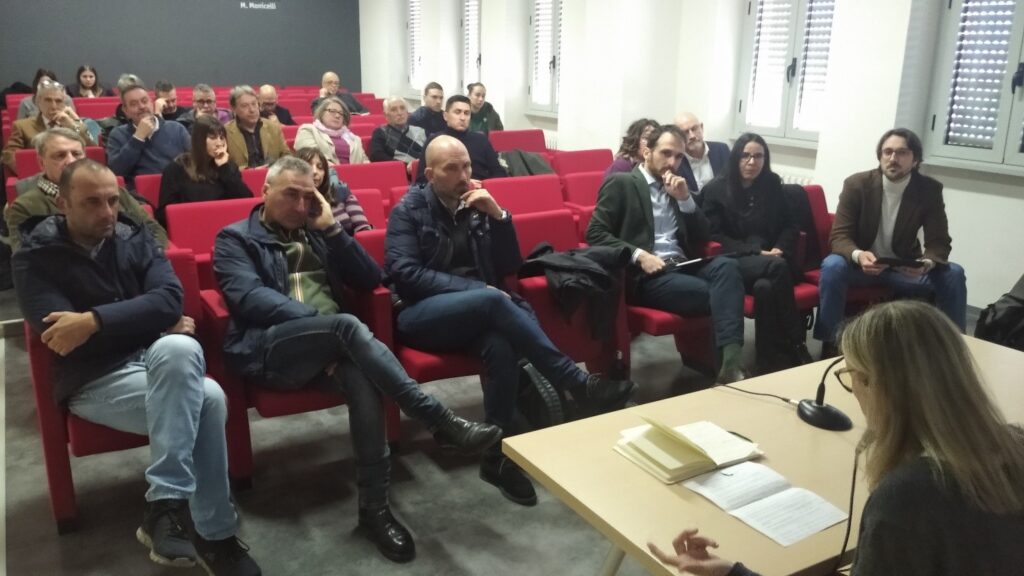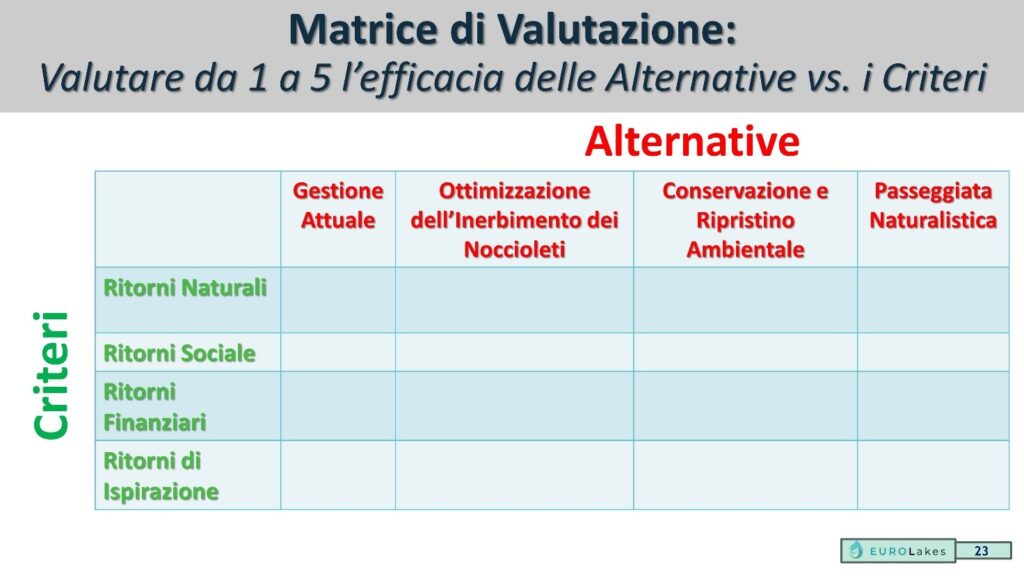



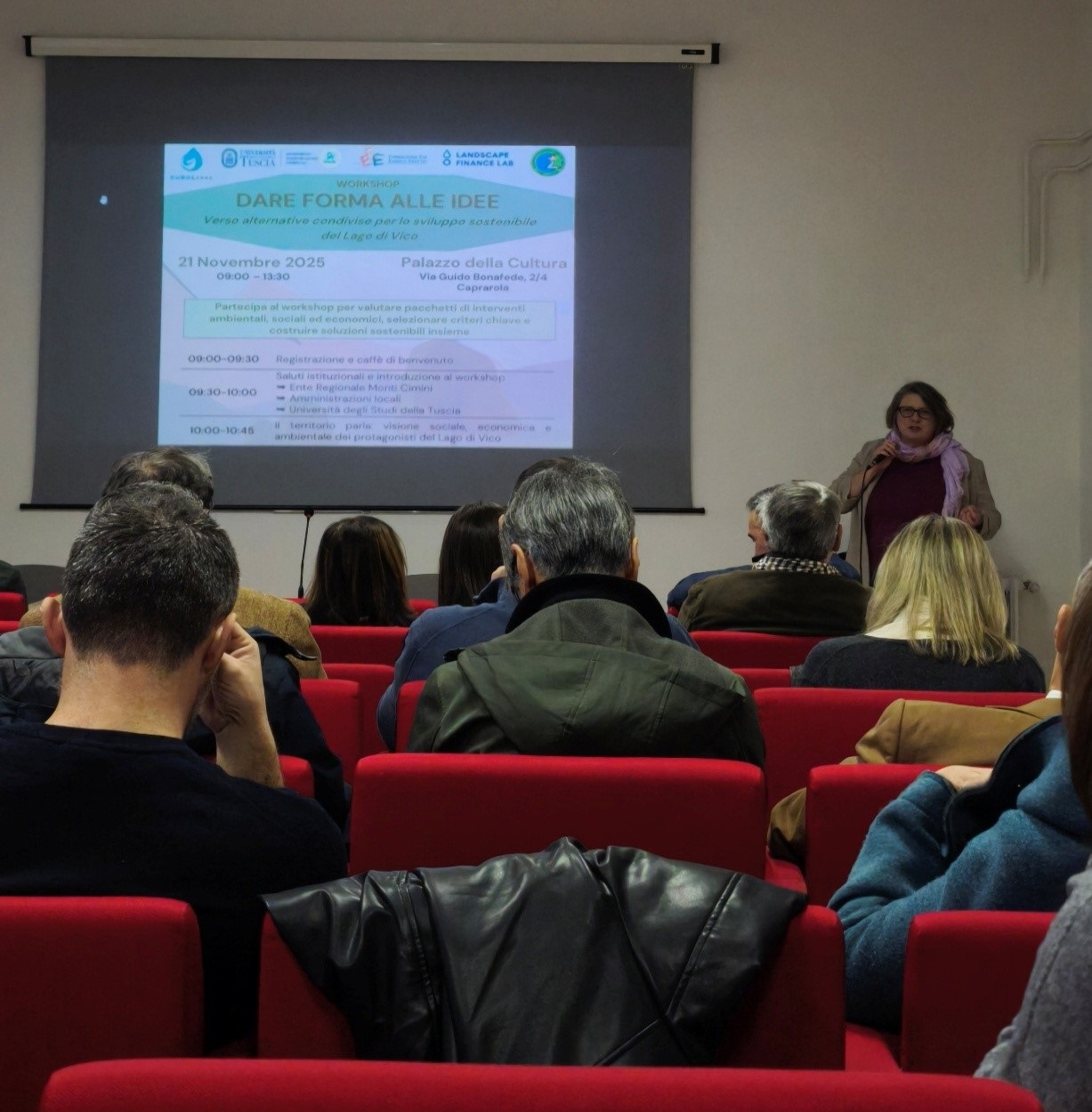
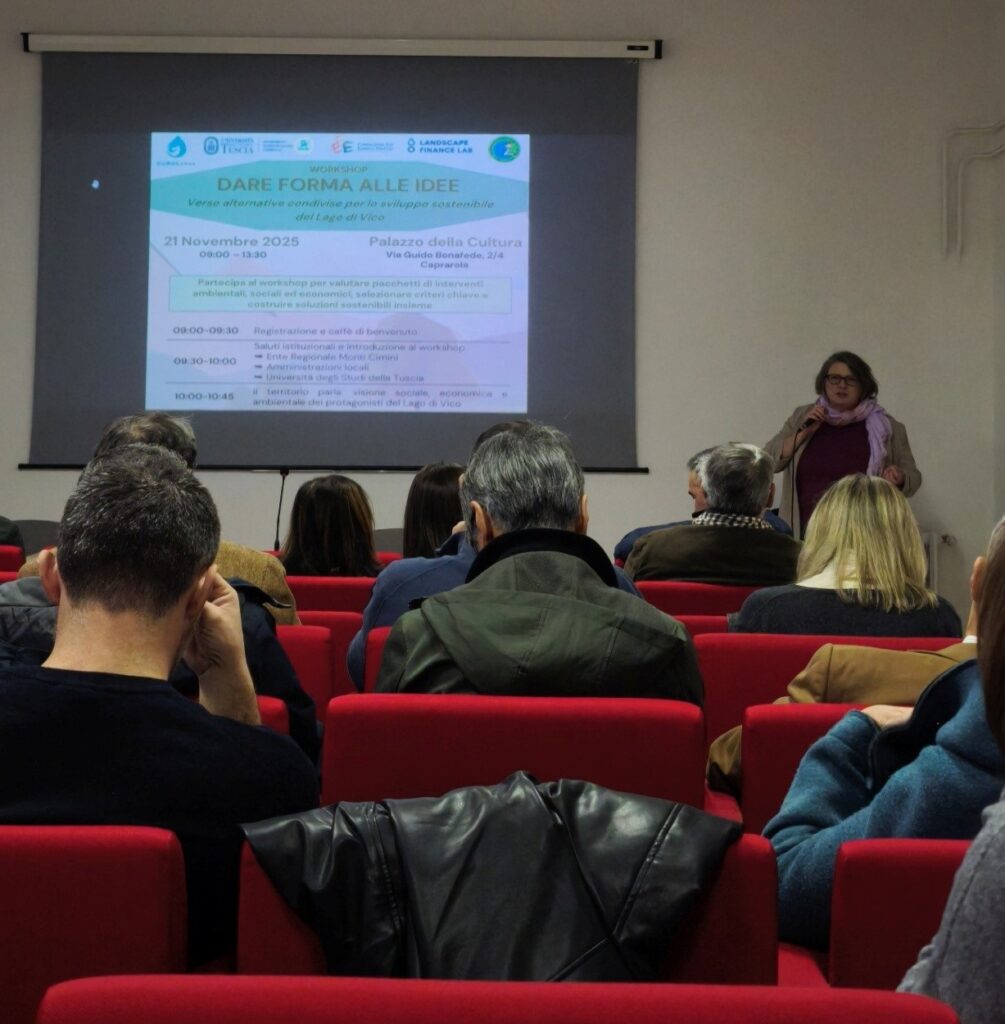
On 21 November 2025, the “Shaping Ideas: Shared Alternatives for the sustainable development of Lake Vico” EUROLakes project held a stakeholder engagement workshop in Caprarola at the Palazzo della Cultura, under the auspices of the Municipality of Caprarola and the Provincial Order of Agronomists and Foresters of Viterbo. Organized by the University of Tuscia (DAFNE Department), the Monti Cimini Regional Authority and the Fondazione Eni Enrico Mattei (FEEM), with the participation of the Landscape Finance Lab, the event brought together around 30 stakeholders representing institutions, associations, farmers, land managers and community groups. Their contributions were essential in initiating an open and constructive dialogue on the future of Lake Vico, with a shared commitment to improving the ecological condition of the lake while preserving the agricultural and touristic identity of the surrounding territory. A central component of the workshop was the Participatory Multi-Criteria Assessment (PMCA) – a decision-support exercise that allows participants to compare different management options using a common set of criteria. The PMCA helps make priorities explicit, highlights where viewpoints converge or differ, and supports the development of solutions that are both shared and evidence-based. In the PMCA exercise carried out during the workshop, participants evaluated four management alternatives in relation to four “returns” — Social, Natural, Financial and Inspirational — each representing a different dimension of value for the territory. The examined alternatives were:
- Current Management: existing practices including spontaneous grass cover, single-direction mechanical mowing of ground cover in environmentally sensitive areas, late-autumn soil scarification and public restoration of riparian vegetation.
- Optimised Grass Cover in Hazelnut Orchards: refining cover crop management and extending ground cover duration to reduce erosion, compaction and runoff.
- Environmental Conservation and Restoration: rebuilding dry-stone walls and terraces, creating vegetated filter strips, installing retention basins and drainage networks and restoring riparian vegetation to strengthen ecological resilience.
- Nature Walk: partial removal or rewilding of crops along the shoreline, creation of a vegetated coastal buffer and construction of a naturalistic walking path for sustainable tourism and environmental education.
On a scale from 1 to 5, each participant individually scored how effective each alternative would be with respect to each of the four returns. The objective of this PMCA exercise was to generate a transparent, comparable and collectively informed foundation for future decision-making, helping to identify which combinations of actions are perceived as most beneficial for the lake, the community and the local economy. In January 2026, the assessment will be relaunched to a wider group of stakeholders to ensure broader representation. Participants who took part in the workshop will also be invited to repeat the exercise using a new digital platform, expected for release in mid-January; this will allow for more consistent data collection, improved analytical quality and better comparison across responses. An information campaign has been launched to share the workshop content and upcoming steps, available via the Facebook group “Lago di Vico Comunità di Eurolakes”. Continued engagement from participants and the wider community will be essential to strengthening this collaborative process and shaping a shared vision for the sustainable future of Lake Vico.