


By Chiara Iavarone, UNITUS
From 3 to 8 May 2026, the European Geosciences Union (EGU) General Assembly brought together thousands of researchers and environmental experts in Vienna for one of the world’s leading conferences on Earth and environmental sciences. Within this international context, the EUROLakes project participated in the conference by presenting two scientific posters focused on freshwater ecosystem restoration and monitoring activities at Lake Vico, the Italian pilot site of the project.
As presenters and researchers from the University of Tuscia, together with colleagues from Fondazione Eni Enrico Mattei (FEEM) and the INTERNATIONAL INSTITUTE FOR APPLIED SYSTEMS ANALYSIS (IIASA) we had the opportunity to share complementary aspects of our ongoing work: participatory governance for Nature-Based Solutions (NBS) implementation and innovative monitoring approaches for diffuse nutrient pollution in agricultural lake catchments.
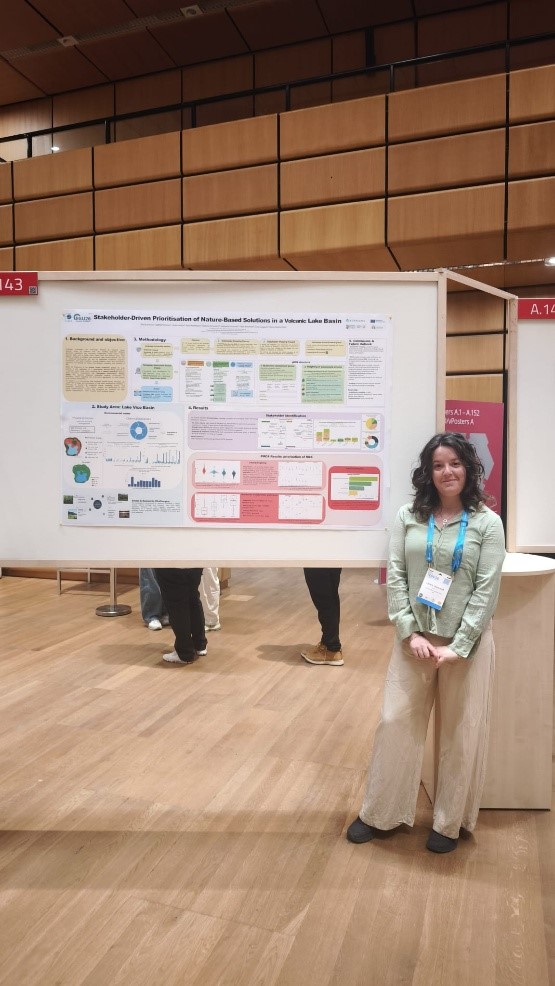
The first contribution was presented during the session “ITS4.9/HS12.5 – ECS” and focused on stakeholder-driven prioritisation of Nature-Based Solutions in the Lake Vico basin. The poster explored how participatory approaches can support the co-design and prioritisation of restoration measures in complex socio-ecological systems.
Lake Vico, a volcanic lake located in Central Italy, is increasingly affected by environmental pressures linked to soil erosion, intensive agriculture, and diffuse nutrient pollution associated with hazelnut cultivation. To address these challenges, the EUROLakes project combines scientific analysis with participatory governance tools. Through stakeholder mapping, workshops, online engagement activities, and participatory multi-criteria analysis (PMCA), local actors were directly involved in evaluating alternative Nature-Based Solutions scenarios.
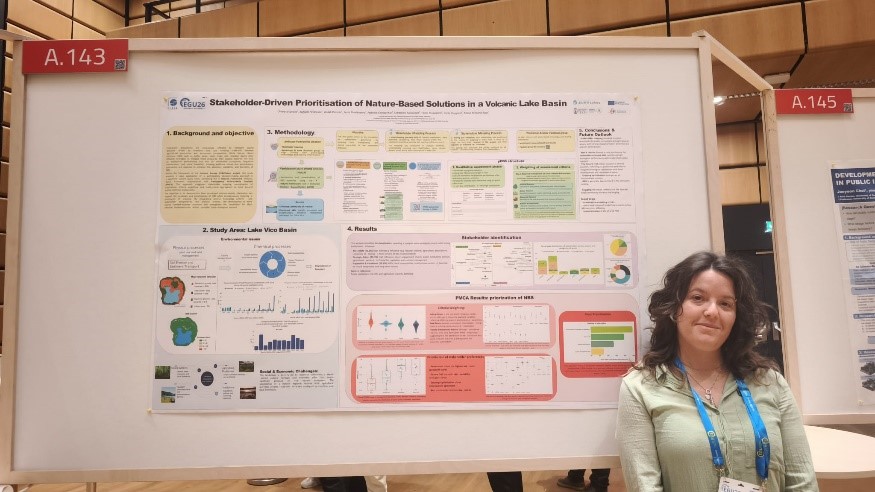
The poster presented preliminary results from this participatory process, highlighting a clear preference among stakeholders for restoration-oriented interventions, especially environmental conservation and restoration actions. The work also demonstrated the importance of building a local community of practice capable of connecting scientific knowledge with local experiences and governance perspectives.
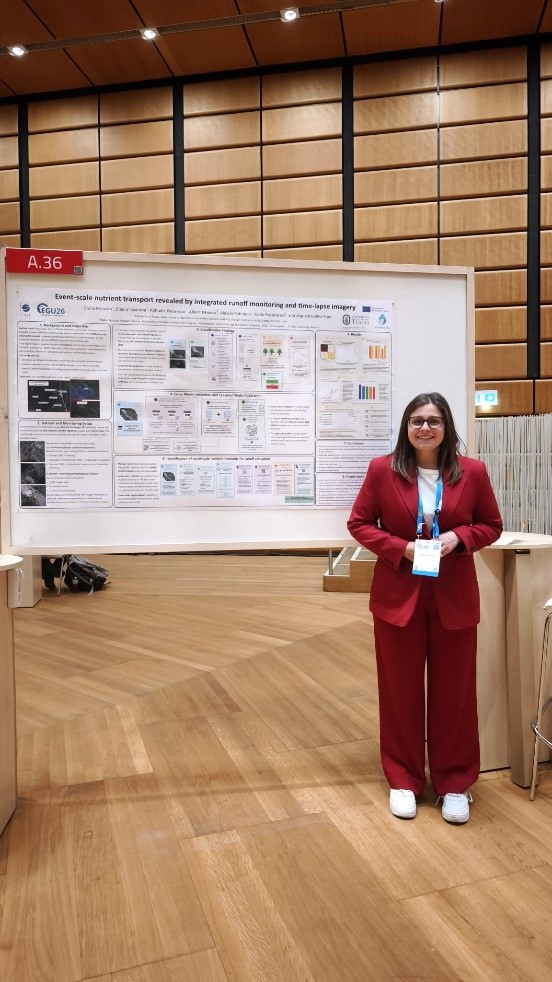
The second poster was presented during the session “HS2.3.6” and focused on innovative approaches for monitoring event-scale nutrient transport in agricultural catchments. Entitled “Event-scale nutrient transport revealed by integrated runoff monitoring and time-lapse imagery,” the work addressed one of the major issues affecting freshwater ecosystems: erosion generated during rainfall–runoff events.
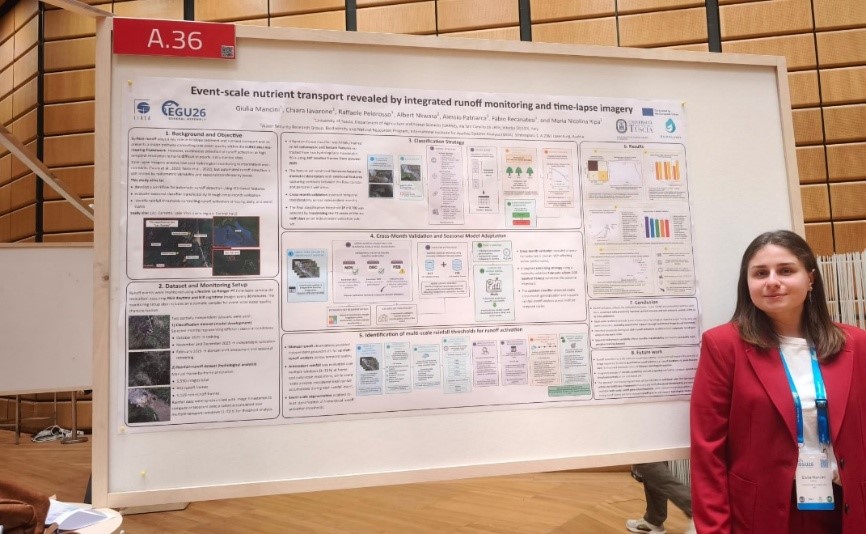
Within the framework of the EUROLakes project, an experimental runoff monitoring system was established in the Cerreto sub-catchment of Lake Vico. The setup combines automatic runoff sampling with a low-cost time-lapse imaging system capable of continuously recording site conditions and runoff occurrence during rainfall events. Based on these observations, a machine learning workflow based on a Random Forest classifier was developed for the automatic detection of runoff from images. The model uses radiometric and textural features extracted from hydrologically significant regions of interest, enabling frame-by-frame classification of images into runoff and non-runoff conditions.
The manually validated observations were then used as independent ground truth data to analyse the relationship between antecedent precipitation and runoff activation at different temporal scales (frame-scale, daily-scale, and event-scale).
The work highlighted how the integration of automatic monitoring, time-lapse imagery, and multi-scale rainfall analysis can represent an effective and low-cost tool for investigating runoff generation processes and nutrient transport in small agricultural catchments. Participating in EGU 2026 represented an important opportunity not only for scientific dissemination, but also for interdisciplinary exchange and international collaboration. Presenting the Lake Vico case study allowed us to contribute to broader discussions on participatory governance, freshwater restoration, hydrological monitoring, and Nature-Based Solutions implementation.
On a broader level, the experience reinforced the mission of the EUROLakes project: promoting integrated and participatory approaches for the protection and restoration of European freshwater ecosystems through collaboration between science, policy, and local communities.