




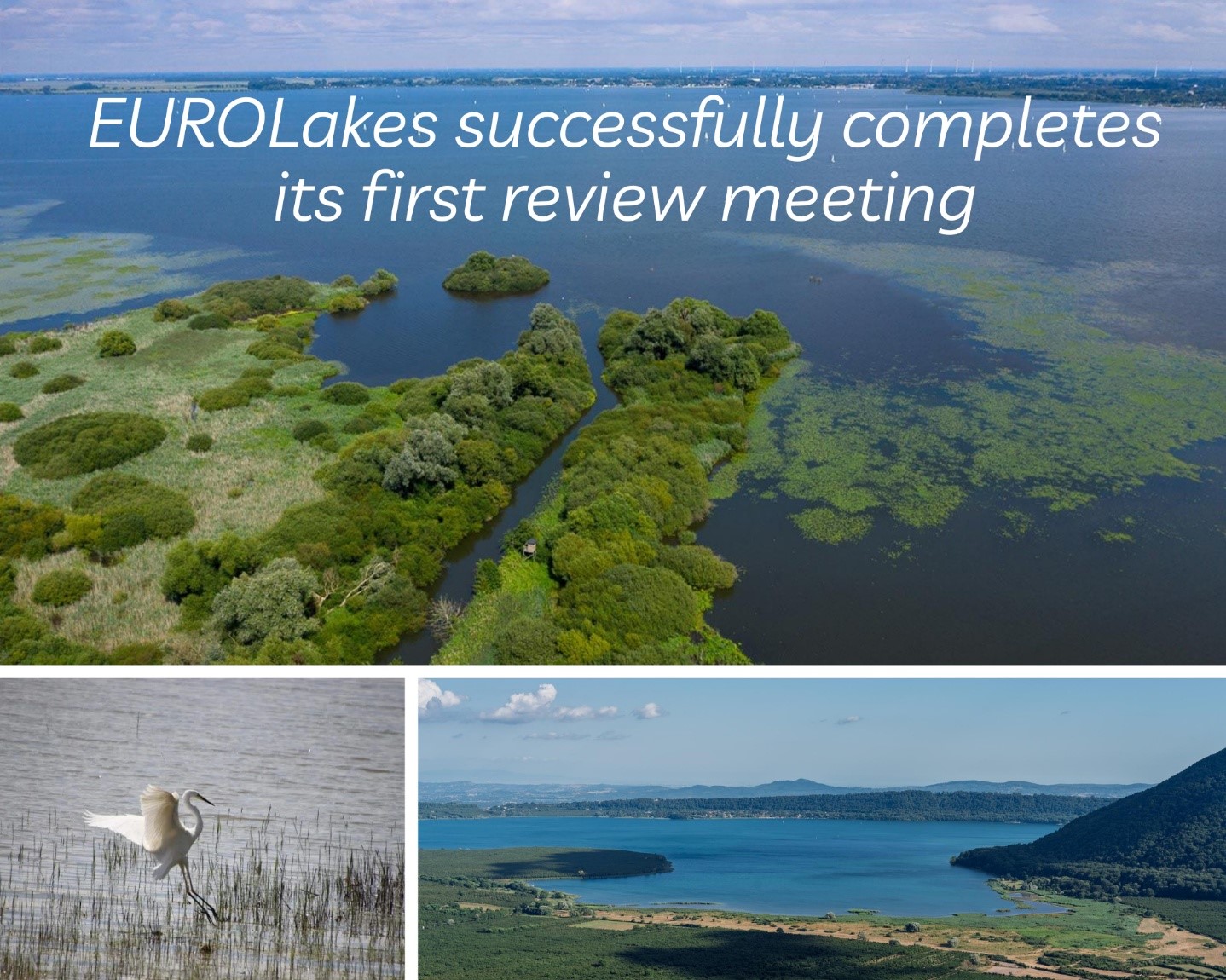
June 19, 2026 was an important day for the EUROLakes consortium who gathered for its first formal project review meeting, marking an important milestone in its mission towards restoring Europe’s lakes through nature-based solutions, collaborative governance and innovative financing approaches.
Bringing together project partners, the European Commission’s Project Officer and an independent external reviewer with extensive expertise in freshwater ecology and lake restoration, the meeting provided an opportunity to reflect on the progress achieved during the EUROLakes first 18 months while openly discussing challenges, lessons learned and the next steps to come.
All participants approached the event as a constructive dialogue, with transparent and open sharing of both achievements and hurdles on the way, recognizing that innovation and ecosystem restoration require continuous learning and adaptation.
Strong foundations across demonstration sites
The review highlighted the significant progress made across EUROLakes’ three demonstration sites, namely, Lake Vico (Italy), Lake Bistret (Romania) and Lake Dümmer (Germany), where the locally established partnerships are already integrating protection and restoration approaches into the landscape.
Across the three lakes, partners have advanced stakeholder engagement activities, strengthened local communities of practice and continued building capacity around the 4 Returns Framework, helping stakeholders explore environmental, social, financial and inspirational benefits of lake restoration.
Co-creation processes have also matured considerably, enabling local communities, authorities and experts to jointly identify restoration priorities tailored to each landscape. The reviewers particularly welcomed the project’s emphasis on participation, while encouraging partners to carefully document both successful approaches and challenges so that future replication efforts across Europe can benefit from these experiences.
Scientific evidence continues to grow
Significant progress has also been made in developing the scientific tools that will support long-term restoration planning. Advanced hydrological models have now been established for all three demonstration catchments, providing valuable insights into nutrient loading, sediment transport and water quality dynamics. As monitoring data continues to accumulate, these models will be further refined and combined with ecological simulations to evaluate different nature-based restoration scenarios and better understand the conditions needed for healthy lake ecosystems to recover.
Meanwhile, ecological monitoring has expanded across all sites, with comprehensive indicator frameworks determined to track restoration progress over time. The reviewing experts acknowledged the solid monitoring architecture already in place and reminded partners to continue strengthening ecological baseline information, to ensure that future environmental improvements can be measured as accurately as possible.
Beyond restoration
One of EUROLakes’ distinctive strengths lies in its holistic approach to lake restoration.
Alongside ecological interventions, the project is exploring innovative financing models capable of supporting long-term restoration efforts beyond the project’s lifetime. Work on ecosystem service valuation, landscape finance and investor engagement continues to progress, helping identify realistic pathways for mobilizing both public and private investment in nature-based solutions. Building continued connections with other Horizon Europe initiatives working on sustainable finance was highlighted as a positive practice that can keep creating further opportunities for knowledge exchange and collaboration in this regard.
Replication gathers momentum
Another important milestone during the reporting period was the launch of the EUROLakes replication programme.
Following strong interest from across Europe, the project selected its first replication sites, demonstrating the growing demand for practical approaches to integrated lake restoration. These new partners will work closely with the consortium to adapt and apply lessons learned from the demonstration sites within their own local contexts.
The importance of documenting not only technical solutions but also governance processes, stakeholder engagement methods and implementation experiences was underscored. Capturing these insights will help ensure that EUROLakes produces practical guidance that is scientifically robust and at the same time directly applicable to future restoration initiatives across Europe.
Communication making an impact
Partners were delighted to hear that the project’s strong communication performance was appreciated.
Halfway through the project, and EUROLakes has already exceeded its website visitor target, while LinkedIn continues to grow as the project’s primary professional communication channel. Campaigns highlighting the 4 Returns Framework, demonstration sites and replication opportunities have successfully reached researchers, environmental organisations, public authorities and other key stakeholders.
Constructive recommendations were made to further strengthen audience analysis and continue tailoring communication activities to different stakeholder groups, ensuring project results reach those who can make the greatest use of them.
Building on valuable recommendations
As with every Horizon Europe project review, the meeting provided an opportunity to identify areas where the project can become even stronger. The consortium was encouraged to present restoration actions and expected ecological outcomes even more clearly, further strengthen ecological baseline information where needed and continue producing concise, user-oriented project outputs that resonate with the needs of different audiences.
These recommendations were welcomed by project partners as valuable guidance that will help maximize the quality, usability and long-term impact of EUROLakes’ results.
Looking ahead
With the first review successfully completed, EUROLakes enters the next phase of implementation recharged and inspired.
Over the coming months, partners will continue to advance restoration activities across the demonstration sites, supporting newly selected replication sites, refining scientific models and monitoring, and further strengthening collaboration with local citizens and organizations, sister projects, and public authorities.
By combining scientific excellence with local knowledge, collaborative governance and innovative financing, EUROLakes continues to demonstrate that restoring Europe’s lakes is not simply an environmental challenge but a shared opportunity to create healthier ecosystems and more resilient communities for the future.
By Ana Hristova, Europroject – Tinexta Innovation Hub